Polarizing Beamsplitters
Featured Product from Avantier Inc.
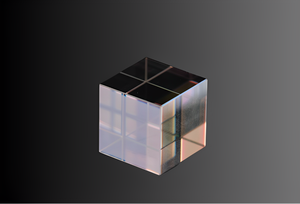
Avantier designs and manufactures plate beamsplitters (in both round and rectangular configurations), cube polarizing beamsplitters, and lateral displacement beamsplitters. A variety of substrates and coating options allow us to customize your polarizing beam splitter order to meet desired wavelength ranges and power-handling requirements.
Avantier's beamsplitters have an extinction ratio of 100:1, along with high surface quality and surface flatness as well as producing Brewster windows and birefringent crystals that are highly resistant to laser damage, providing polarization cleanup in potentially compromising situations.
Types of Polarizing Beamsplitters
Polarizing beamsplitter can be divided into three categories: polarizing plate beamsplitters, cube beamsplitters, and lateral displacement beamsplitters. All three types separate the light radiation into two beams with orthogonal polarization. In a perfect beamsplitter, the ratio of reflected to transmitted light will always be 50/50.
- Polarizing plate: Hard-coated substrate (e.g., UV fused silica) with high transmission, extinction ratio, and damage threshold. Used at 45°, with an engraved arrow marking light direction. Reflects s-polarized light and transmits p-polarized.
- Polarizing cube: Two prisms cemented along the hypotenuse with a dielectric coating. Durable and easy to mount, with broadband AR coatings. Laser line AR options: 532, 633, 780, 980, 1064, or 1550 nm.
- Lateral displacement: A rhomboid prism cemented to a λ/8 right-angle prism, with AR and polarizing coatings. Less common than plate or cube types, but useful for simplifying benchtop layouts.
The factory standard specifications of these Beamsplitters are as follows:
| Material | Schott, Ohara, CDGM Optical Glass, Corning fused silica, JGS1, JGS2 |
| Surface Flatness | λ/4 |
| Dimensions | +0.1 mm |
| Beam Deviation | < 5 arcmin |
| Surface Quality | 40-20 |
| Extinction Ratio | 100:1 |
Please contact us for more information on our manufacturing capabilities or to schedule an introductory consultation.
Related Content
How to Select a Beamsplitter
Case Study: Double Convex Lens for Indirect Ophthalmoscopes
Dichroic Beamsplitters
Laser Line Polarizing Plate Beamsplitters
Beamsplitters
How Do Polarizing Beam Splitters Work?