Pump Energy Efficiency
Featured Product from Blacoh Fluid Control, Inc.
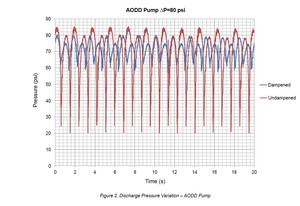
The amount of energy used by a positive displacement pump is proportional to the pump’s differential pressure. The higher the pressure added by the pump, the harder the pump is working. Reciprocating pumps accelerate the mass of fluid in the discharge line with each discharge stroke, which results in pressure spikes. A pulsation dampener reduces pressure amplitude by accumulating a percentage of fluid at discharge pressure and releasing it back into the system during the inlet stroke of the pump. With this setup, the pump only has to accelerate the fluid between the pump discharge and the dampener as the velocity of the fluid in the rest of the line remains relatively constant. Reducing discharge line pressure variation therefore reduces the total amount of energy required to support the application.
Several tests were completed using different peristaltic pumps and piping to simulate a variety of pumping conditions. The decrease in energy used over time when the pulsation dampener was added in the system ranged from 3.9% up to 34.1% depending on the setup and differential pressure created. As seen in Figure 1 below, test results using a 2.5” peristaltic pump showed a 12% reduction in energy used over time by comparing the areas under the curve for a dampened and undampened system over a 5 minute test. In all cases tested, energy savings achieved with the dampener increased with higher pump differential pressures.