
Gearheads
Featured Product from C.I. Takiron Corporation
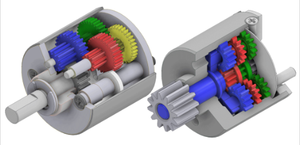
This mechanism reduces the rotational speed and increases torque by connecting to the output shaft of the motor.
There are two main types: the spur gear head, which has a simple structure and high efficiency, and the planetary gear head, which has high mechanical strength.
Spur gears with 12 and 16 diameters are available.
?Features
The text describes a type of gearbox where two interlocking gears have parallel axes, which is one of the common forms of gearboxes.
Due to its simple structure and ease of achieving precision, it features minimal mechanical loss and high transmission efficiency.
However, to output high torque, it is necessary to increase the number of stages, which results in a larger size and reduced efficiency.
Planetary gears of 16 and 12 diameters are available.
?Features
The planetary gearbox has a structure consisting of a sun gear at the central axis, surrounded by planet gears, and a carrier.
The planetary gears rotate around the sun gear, and this orbital motion is transmitted through the carrier to the output shaft, which is coaxial with the input shaft.
This design allows force to be distributed to multiple planetary gears, resulting in a high allowable torque.
Nout = Nin / i
Nout : Output speed
Nin : Input speed
Tout = Tin × i × η
Tout: Output torque
Tin : Input torque
i : Reduction ratio
η = η1 × η2 × ... ηn
η : Transmission efficiency
(η1 : First stage)
(η2 : Second stage)
* In the case of a spur gear, ηη is calculated as 0.9
* In the case of a planetary gear, ηη is calculated as 0.85
Since the above calculation uses theoretical values, it varies depending on speed, load, and temperature condition in practical use.