Spherical Plano Concave Metallic Mirrors
Featured Product from Changchun Yutai Optics Co., Ltd.
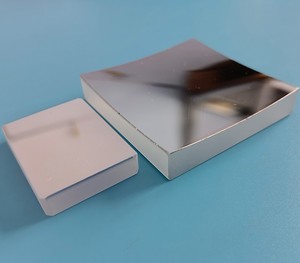
These mirrors combine the optical focusing and dispersion characteristics of a spherical surface with the high reflectivity of a metal coating, and are commonly used in laser resonance cavities, beam shaping, optical imaging systems, and other fields.
Basic structure and optical properties of spherical concave metallic mirrors
Concave coating (commonly used): reflection occurs on the concave side, light convergence or divergence is determined by the radius of curvature.
Plano coating: reflection occurs on a plano surface, the concave surface is only used for refraction correction of the transmitted light path.
| Parameter | Description |
| Radius of curvature (R) | Determines the focal length (f = R/2). Negative values indicate concave surfaces (converging light). Positive values are convex (uncommon for plano concave mirrors). |
| Aperture (D) | The effective clear aperture must match the beam diameter to avoid vignetting. |
| Focal Length (F) | Directly related to the radius of curvature, affecting beam control capability. |
| How are the materials for spherical plano concave mirrors selected? | ||
| Substrate Material | Thermal Expansion | Applicable Scene |
| BK7 | ~7.1×10??/K | Lowcost visible applications with moderate accuracy requirements. |
| Fused Silica | ~0.55×10??/K | High power laser (low thermal distortion), UV band. |
| Silicon | ~2.6×10??/K | Infrared lasers (e.g. CO?), but with anti-reflective coating. |
| D263T | ~7.1×10??/K | Ultra-thin, lightweight systems (e.g., portable devices) requiring chemical reinforcement. |