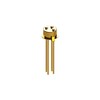
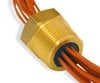
Immersion Cooling Feedthrough Protect Data Centers
Featured Product from Douglas Electrical Components

A 2025 outage at the Chicago Mercantile Exchange—triggered by a cooling system failure—highlighted how vulnerable high-performance digital infrastructure is to thermal issues. This same risk affects AI clusters, supercomputers, and research systems, where cooling failures can halt operations, corrupt long-running processes, and lead to major financial and operational losses. As computing power density continues to rise, traditional air and liquid cooling systems struggle to keep up, introducing more failure points through complex mechanical systems.
Immersion cooling offers a more reliable solution by submerging hardware in dielectric fluid, enabling efficient, uniform heat removal and supporting extreme power densities exceeding 50–100 kW per rack. However, while immersion cooling solves heat transfer challenges, it introduces a critical engineering requirement: maintaining a sealed boundary where power, signal, and data connections pass through the tank.
Immersion cooling feedthroughs address this need. These hermetically sealed components allow electrical connections to pass through tank walls while preserving fluid containment, electrical isolation, and system integrity. Properly designed feedthroughs prevent fluid leaks, contamination, corrosion, and electrical faults (key risks that can lead to system failure or downtime).
They also support long-term reliability by withstanding thermal cycling, maintaining dielectric fluid purity, and enabling real-time monitoring through integrated sensors. For mission-critical environments such as hyperscale AI data centers, financial exchanges, and supercomputing facilities, these feedthroughs are essential for ensuring uptime, performance, and safety.
Designing effective immersion feedthroughs requires careful attention to material compatibility, electrical load capacity, signal integrity, and long-term durability. When engineered correctly, they become a foundational component in preventing cooling-related failures and future-proofing high-density computing systems.