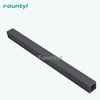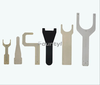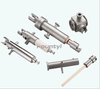
High-Precision Alumina Ceramic End Effector
Featured Product from Fountyl Technologies Pte. Ltd.

Every wafer in a semiconductor fab is handled — picked, placed, transferred — by a robot end effector. It is the single point of contact between the automation system and the product. For decades, aluminum has been the standard material. But as wafer sizes grew and critical dimensions shrank, the limitations of metal became harder to ignore.
Why Alumina Outperforms Metal
The end effector must be stiff enough to carry a 300mm wafer at high speed without vibration, yet thin enough to reach into tight chamber clearances. Aluminum end effectors are typically 5–8mm thick to achieve the required stiffness. Alumina ceramic, with roughly four times the specific stiffness of aluminum, achieves the same rigidity at half the thickness. This thinner profile means better access to process modules and reduced turbulence during wafer transfer.
The material difference goes beyond stiffness:
Hardness — Alumina (Al?O? 99.5%) measures ~1600 HV, over ten times aluminum's ~150 HV. Aluminum end effectors wear over time, creating sharp burrs that scratch wafers and generate metal contamination. Alumina contact surfaces maintain their geometry through millions of cycles with near-zero particle generation.
Thermal stability — Alumina expands at 8 ppm/°C, about one-third of aluminum's 23 ppm/°C. This means the end effector maintains its dimensional accuracy across the temperature swings typical in vacuum and atmospheric wafer transfer.
Surface inertness — Alumina does not corrode, does not outgas, and does not react with process chemistries. No coating, anodizing, or surface treatment is needed.
Designed for the Robot Interface
Fountyl end effectors are precision-ground to tight tolerances. Typical thickness tolerance is ±0.05mm, flatness within 0.1mm, and surface roughness Ra ≤ 0.4μm. Mounting hole patterns, locating features, and vacuum ports are machined to match specific robot models — Brooks, Kawasaki, Yaskawa, and custom OEM designs. Each effector is ultrasonically cleaned, inspected under microscopy, and packaged in cleanroom-compatible sealed bags.
Where It Matters
- Wafer transfer robots — atmospheric and vacuum environments
- Sorters and stockers — high-cycle pick-and-place
- Wet bench handling — corrosion resistance against chemical baths
- Inspection and metrology tools — dimensional stability under temperature variation
Reliable at Scale
Alumina end effectors do not require periodic rework or surface treatment. They do not outgas, do not corrode, and do not deform under repeated thermal cycling. For fabs running 24/7, the switch from metal to ceramic translates directly to fewer particle excursions, fewer wafer scratches, and longer preventive maintenance intervals.
Fountyl Technologies Pte. Ltd. is a Singapore-based advanced ceramics manufacturer integrating R&D, precision manufacturing, and sales. The company supplies precision ceramic end effectors and other wafer handling components to semiconductor equipment OEMs and fabs worldwide.