How Do Linear Motors Work?
Featured Product from HIWIN Corporation

A conventional 3-phase AC synchronous rotary motor uses a central rotor with magnets and a stationary rotary coil that generates a rotating magnetic field. A linear motor follows the same principles but with the coil typically being the moving part and the magnets being the stationary part. The magnets used are often high-strength permanent magnets to increase the force density. All HIWIN motors are closed-loop servos and require a position feedback system such as a linear encoder. A servo drive uses the position feedback attached to the moving carriage to coordinate the output to each of the 3 phases, allowing for smooth motion and high positional accuracy.
HIWIN offers two motor types: Iron-core and Ironless.
Iron Core Linear Motors
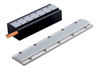
Iron-core motors are ideal for high-speed, high acceleration, point-to-point applications. The iron-core motors offer an estimated 0.5 to 0.75 N per cubic centimeter. The LMSA series is HIWIN’s standard iron-core series offering a max continuous force of 1,579N and a max peak force of 4,458 N.
The LMFA is HIWIN’s water-cooled iron-core series. The LMFA has an optimized coolant path built into the motor. By forcing coolant through the motor to remove heat, the motor can achieve higher continuous forces. The LMFA offers a max continuous force of 7,917 N and a max peak force of 20,827 N.