Maximizing Output with Stack Molds
Featured Product from Husky Technologies™
To stay competitive in today’s market, plastic packaging manufacturers must strive for ways to achieve higher productivity, increased flexibility and reduced costs. Our latest article shows you how Husky stack mold technology can help you leverage equipment to maximize output and meet consumer demand.
It’s no secret that to remain competitive in today’s market, plastic packaging manufacturers must constantly strive for ways to achieve higher productivity, increased flexibility and reduced costs.
Stack molds are one of the most cost-effective ways to achieve these goals, helping you increase injection molding system output by up to 100% percent with a relatively low additional investment or disruption. Here’s how.
What are stack molds and which applications are they suited to?
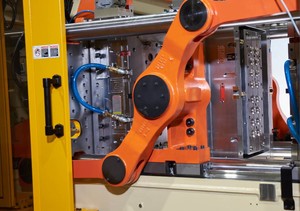
Compared to standard molds that have just one molding surface or parting line, a stack mold can have two, three or four parting lines. The opening, closing and remaining stages of the injection molding cycle take place in parallel for all stack mold faces, resulting in minimal cycle time increases.
While a stack mold can be used for increasing productivity on a wide range of applications, the technology is most beneficial for parts with low height that do not require large mold opening strokes. The most popular applications are closures, thinwall containers, lids and medical applications.
How does it work?
The unique design of a stack mold places particular challenges on the injection molding machine itself. As a result, the decision to use a stack mold solution must be made at the very early stages of a project. Here are some important points to consider.
What are the machine requirements?
While significantly enhancing output rates, the additional plates that stack molds require must be handled appropriately to ensure part quality and tool longevity. Firstly, the clamping unit should be capable of carrying the higher weight of the stack mold without the middle mold section sagging and with minimum platen tilting. Secondly, the press should be capable of a higher opening stroke and shut height. The injection unit should be able to support the extra output with a larger shot size and higher recovery speed and injection rate. Thirdly, the mold itself should be equipped with a hot runner system that ensures balanced flow and temperature to each cavity.