ZTA Ceramic Components for Medical Devices
Featured Product from Shenzhen Great Precision Ceramic CO., LTD.

Engineering overview
Zirconia Toughened Alumina (ZTA) is an advanced technical ceramic composite in which zirconia particles are dispersed in an alumina matrix. This structure is used when engineers need more fracture resistance than conventional alumina while retaining high hardness, wear resistance, chemical stability and dimensional reliability. Great Ceramic supplies custom ZTA components for applications where metal, polymer or monolithic ceramic parts may be limited by abrasion, corrosion, cyclic loading or high-temperature service.
Typical industries and component applications
Medical equipment and instrumentation
Typical applications: Wear components, insulating parts, precision guide parts, surgical tool components, dental or orthopedic-related ceramic parts where the design calls for a hard and stable ceramic.
Why ZTA is specified: High hardness, fracture-toughening behavior, electrical resistivity, corrosion resistance and the ability to be ground and polished for critical surfaces.
Pumps, valves and fluid handling
Typical applications: Plungers, shafts, valve seats, washers, sleeves, blocks and seal-contact parts exposed to abrasive fluids or slurries.
Why ZTA is specified: Wear resistance, chemical resistance and flexural strength for parts exposed to repeated mechanical load and fluid contact.
Chemical and pharmaceutical processing
Typical applications: Metering, dosing, carrier, guide and contact components used around aggressive fluids or clean processing environments.
Why ZTA is specified: Ceramic corrosion resistance, low contamination risk and dimensional stability in demanding process conditions.
Industrial machinery and precision tooling
Typical applications: Wear plates, guide rails, bushings, rollers, positioning components and other sliding or contact surfaces.
Why ZTA is specified: Hardness, low-friction surface potential after polishing and resistance to deformation compared with many metallic wear parts.
Aerospace, defense and high-performance equipment
Typical applications: Lightweight structural wear components, high-strength insulating parts and precision ceramic hardware.
Why ZTA is specified: Combination of strength, thermal stability, hardness and corrosion resistance for severe service environments.
Material performance reference
Typical material values are shown below for engineering screening. Final specifications depend on ceramic grade, part geometry, surface finish and operating conditions.
Material system
Typical value or range: Alumina matrix with zirconia toughening; typical zirconia content can be specified in the 15%-25% range depending on grade.
Engineering relevance: Balances alumina hardness with zirconia-based resistance to crack propagation.
Density
Typical value or range: 4.0-4.38 g/cm3
Engineering relevance: Useful for mass, inertia and design calculations.
Hardness
Typical value or range: 16.0-17.0 GPa Vickers; approximately 1600-1800 HV depending on grade and test method.
Engineering relevance: Supports abrasive wear resistance and durable sliding/contact surfaces.
Flexural strength
Typical value or range: 600-800 MPa
Engineering relevance: Important for parts under bending, cyclic load or contact stress.
Fracture toughness
Typical value or range: 4.5-6.0 MPa.m1/2
Engineering relevance: Helps resist crack growth compared with more brittle monolithic ceramics.
Thermal conductivity
Typical value or range: 17-30 W/mK at 20 C
Engineering relevance: Relevant where heat dissipation or thermal gradients affect component reliability.
Coefficient of linear thermal expansion
Typical value or range: 7.2-7.7 x 10^-6/K from 40-400 C
Engineering relevance: Supports tolerance planning when ZTA is paired with metals or other ceramics.
Maximum working temperature
Typical value or range: 1500-1650 C, depending on grade and service environment
Engineering relevance: Supports high-temperature equipment and process compatibility screening.
Electrical resistivity
Typical value or range: >10^14 ohm.cm
Engineering relevance: Supports insulating components and electrically isolated tooling designs.
How ZTA improves component reliability
ZTA's toughness comes from the interaction between zirconia particles and the alumina matrix. Under stress, zirconia particles near an advancing crack can generate localized compressive stress that helps slow crack growth. In practical component design, this means ZTA can be considered when a part needs the hardness and wear resistance associated with alumina but also needs improved resistance to crack propagation under impact, vibration or cyclic loading.
Design and manufacturing considerations
- Use generous internal radii and avoid sharp corners where possible, because ZTA remains a ceramic and stress concentration should be minimized.
- Define working environment early, including temperature, fluid chemistry, load, mating materials and surface finish requirement.
- For sliding, sealing or medical-instrument components, grinding and polishing requirements should be specified together with dimensional tolerances.
- Great Ceramic supports custom ceramic machining, grinding, polishing, laser cutting, molding/forming and application support for engineered ceramic components.
Available custom component forms
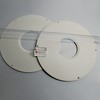
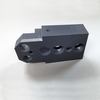
Great Ceramic's ZTA product category includes plungers, blocks, washers, shafts and pumps, and custom geometries can be developed for application-specific wear, insulation, fluid-handling and precision mechanical requirements. Engineering teams can use ZTA as a candidate material where conventional alumina, zirconia, metals or polymers do not provide the required balance of hardness, toughness, corrosion resistance and service temperature.