

Material Selection Service / Material Replacement
Service Detail from Top Seiko Co., Ltd.
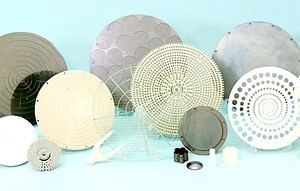
Do you have any problems with the material that you currently use?
In some cases, the problems can be solved by replacing the materials. For example, if your problems are in the heat resistance, the thermal conductivity, or the wear resistance, we recommend you stop using acryl, steel, stainless steel, or aluminum. Those materials should be replaced with ceramics or refractory metals such as tungsten, molybdenum, and tantalum, and that will lead you to the solution.
We are the expert in machining those materials which are difficult to machine, especially when tight tolerances are demanded.
Also, as we are not a material supplier and we purchase material from various suppliers, you can choose the material from a wide range of a list. Below are some succeeded examples of material replacement.
Examples of Material Replacement
| Required Property | Applications & Problems | Commonly Used Materials | Recommended Materials |
|---|---|---|---|
| High-Temperature Resistance | ?The part used under a high-temperature environment requires frequent replacement due to its short service life, resulting in high cost and downtime. ?The part used at high-temperature warps and distorts while in use, and these thermal deformations cause decreases in the dimensional accuracy of final products it produces. |
Heat-Resistant Resin/Plastic Aluminum Alloy Steel Stainless Steel |
Fused Silica Glass Borosilicate Glass Alumina Zirconia Silicon Nitride Molybdenum/ Molybdenum enum Alloy Tungsten / Tungsten Alloy |
| Low Thermal Expansion | ?Due to its low dimensional stability, the part expands at high temperatures, causing problems in dimensional accuracy and repeatability of the final products it produces. ?A material with the low thermal expansion is needed to make a part that can maintain its performance and dimensional stability without being affected by constant changes in temperature. |
Aluminum Alloy Steel Stainless Steel |
Alumina Aluminum Nitride SiC-based MMC Molybdenum Tungsten |
| High Thermal Conductivity | ?A material with high thermal conductivity is required for use in fast heat removal & high-temperature applications. ?Due to its low thermal conductivity at high temperatures, the critical parts for thermo-compression bonding cannot conduct sufficient heat which results in low productivity. |
Stainless Steel Heat-Resistant Alloys Ceramics |
Molybdenum Tungsten Aluminum Nitride Silicon Carbide SiC-based MMC |
| ?It is very hard to find a material that meets all of the requirements: high-temperature resistance, good thermal conductivity, and excellent electrical insulation property. | Aluminum Nitride | ||
| High Thermal Shock Resistance | ?The uses of low thermal shock resistant materials prevent manufacturers from improving their products which can be achieved by rapid heating and cooling. For example, if the mold material is not thermal shock resistant enough, rapid changes in temperature will cause distortion and cracking in molds. | Aluminum Alloy Steel Stainless Steel Ceramics |
Silicon Nitride Aluminum Nitride Alumina Molybdenum Tungsten. |
| Low Thermal Conductivity | ?The part operated at high temperatures loses heat too quickly because of its thermal conductivity. This heat loss by conduction causes variations in the quality of the products. A material that can both retain heat longer and withstand high temperature is needed to replace with current material to stabilize quality. |
Ceramics | Zirconia Machinable Ceramics Fused Silica Glass Borosilicate Glass |
| High Hardness Wear Resistance Scratch Resistance |
?Rapid wear causes a part to lose its dimensional accuracy, resulting in frequent replacement of the part. ?High scratch-resistance is required. |
Hardened Steel Conventional Metal(non-refractory) |
Alumina Zirconia Silicon Carbide Silicon Nitride Tungsten Carbide |
| ?The optical component cannot stay transparent due to the damaged surface caused by scratches and abrasion during use. An extremely hard, optical material is needed to produce high-scratch resistant optical components. | Acrylic Glass |
Fused Silica Glass Sapphire |
|
| High Fracture Toughness Resistance to Chipping, Cracking, and Breaking |
?Alumina is a popular material for precision machined parts. However, it is brittle and susceptible to breaking, chipping, or cracking due to impact. A material with higher fracture toughness should be considered as an alternative material. |
Alumina | Zirconia Silicon Nitride |
| Electrical Insulation Properties at High Temperature | ?A material ideal for high-temperature electrical insulation applications is needed as parts require higher heat resistance than heat-resistant resins. | Heat-Resistant Resin/Plastic | Alumina Machinable Ceramics Biron Nitride |
| High Electrical Conductivity at High Temperature | ?An electrical conductive material with much higher temperature resistance than conventional metals is needed as they cannot withstand the intense heat. | Copper Other Conventional Metal(non-refractory) |
Molybdenum Tungsten |
| High Density | ?A high-density material which enables the part to maintain its weight while reducing its size is required to improve the compactness of the product. | Conventional Metal(non-refractory) | Tungsten Tungsten Alloy |
| Corrosion Resistance Oxidation Resistance Alkali Resistance |
?The part rusts quickly due to its constant exposure to air and water. Replacing the metallic material with a?material that can resist oxidizers is essential to end the rust problem. ?To prolong the service life of a part, it is crucial to find a material that can be used in harsh and corrosive environments that metals cannot survive. | Conventional Metal(non-refractory) | Fused Silica Glass Alumina Zirconia (Zirconium Oxide) |
| Cost | ?Cost reduction of ceramic parts with fine features and complex shapes is needed. ?High precision and complex parts in engineering ceramics are too expensive to meet cost requirements. |
Alumina Aluminum Nitride Silicon Nitride Silicon Carbide |
Machinable Ceramics |