Wave Spring Design Guide and Application
Featured Product from Zhejiang Lisheng Spring Co., Ltd.
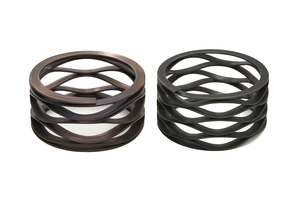
This guide provides an overview of wave spring design principles and typical applications.
1. Design Overview
A wave spring is formed by coiling flat wire with several waves per turn. The number of waves, number of turns, material thickness, and inner/outer diameters all affect the load and deflection characteristics. Engineers must define working load, free height, operating height, and required life cycles. Multi-turn wave springs offer higher loads and smoother force curves, while single-turn versions are suitable for low-deflection applications. Nested designs provide extremely high loads for heavy-duty equipment.
2. Material Selection
Material choice directly impacts performance. Stainless steels such as SUS301 and SUS304 are widely used for general industrial applications, while SUS316 is selected for corrosive environments. For high-temperature or high-strength requirements, Inconel X-750, Inconel 718, and Elgiloy are preferred. Surface treatments such as passivation, black oxide, or electropolishing enhance corrosion resistance and fatigue life.
3. Performance Advantages
Wave springs offer several engineering benefits:
-
Significant axial space savings
-
High load accuracy and stable deflection curve
-
Weight reduction compared to round-wire springs
-
Reduced assembly tolerance stack-up
-
Suitable for high-speed and high-precision mechanisms
These features help designers develop smaller, lighter, and more efficient equipment.
4. Industrial Applications
Wave springs are widely used across multiple industries:
-
Bearings: Provide consistent preload to reduce vibration, noise, and wear.
-
Valves and Pumps: Maintain sealing force, compensate thermal expansion, and stabilize axial movement.
-
Mechanical Seals: Ensure uniform face loading in high-pressure and high-temperature conditions.
-
Automotive and EV Components: Used in transmission systems, clutches, actuators, and precision modules.
-
Aerospace: Lightweight, heat-resistant materials support demanding environments.
-
Medical Devices: Compact size and precise load control suit pumps, surgical tools, and diagnostic equipment.
-
Motors and Actuators: Control endplay and improve efficiency.
5. Design Considerations
To achieve optimal performance, engineers should:
-
Match spring dimensions to housing/shaft tolerances
-
Avoid overstressing at maximum compression
-
Select proper materials for temperature and corrosion requirements
-
Confirm load and deflection through testing or manufacturer support
Lispring provides custom wave spring design, engineering consultation, and rapid prototyping to support specific application needs.
Wave springs continue to play a key role in modern industrial design, helping engineers achieve high performance in increasingly compact mechanical systems.