Warehouse Encoder Solutions for Automation
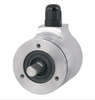
Featured Product from Encoder Products Company
Warehouse Encoder Solutions for Automation
In recent years, manufacturers and retailers have made extensive investments in automating material handling systems inside and around warehouses and distribution centers. Contributing factors are increased demand from online businesses, the need for increased productivity in the midst of a challenging labor market, and worker safety mandates.
Pick and place robots, systems
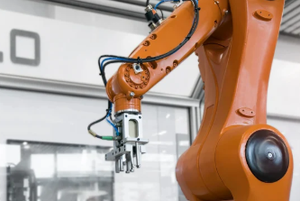
In the warehouse environment, pick and place robots are used at transfer points, such as cartoning, palletizing, sorting, and order picking. Typically, encoders are employed to aid the infeed of items to the robot via conveyor, with encoder signals used for speed information in conjunction with a vision sensor. Encoder placement and specification should align with the typical conveyor feedback options for wheeled, shaft-mount and thru-bore types.
AMRs, AGCs, Forklifts
A mainstay of warehouse operations for decades, forklifts are being fitted with added sensors, including encoders, to aid with productivity and worker safety. More recent entrants to the warehouse ecosystem, autonomous mobile robots (AMRs) and automated guided vehicles (AGVs) must accomplish a variety of complex tasks in dynamic operating environments. To meet performance objectives safely and efficiently, these vehicles rely on encoders for steering, propulsion, and storage and retrieval functions.
Drive motor and steering control
For drive motor applications in AGVs and AMRs, encoders with compact housings are preferred due to the space constraints in most mobile platforms. With long duty cycles, heavy loads, and frequent acceleration and braking, encoders with high-temperature ratings (100° C or higher) are a must. Thru-bore options are generally preferred.
For AGV steering applications, the encoder may be fixed to the motor that operates the steering mechanism, the steering shaft, or both. Depending on the control system, incremental or absolute encoders can be applied.
Forks benefit from linear motion feedback
Both human-operated and autonomous forklifts can benefit from encoder feedback. For controlling vertical positioning of the forks, a draw wire encoder can be applied to the tower as either primary or secondary feedback in combination with other sensors. Extendable forks can also use draw wire encoders on the horizontal axis.
Redundant encoders for safety
Autonomous vehicles in warehouses and other facilities must adhere to safety standards due to the inherent hazards of operating heavy mobile equipment alongside human workers. To comply with functional safety requirements in AMR and AGV applications, redundant sensor feedback is necessary. Two separate sensing methods are preferred, such as both an optical and a magnetic encoder in a combination device. Functional safety requirements are challenging today’s system designers to identify sensors that are both safety compliant and cost effective.