
6.28 Ratchets and Pawls
Description
6.28 Ratchets and Pawls are mechanical components used to control motion in one direction. They consist of a ratchet wheel with teeth and a pawl that engages these teeth to allow movement in one direction while preventing motion in the opposite direction. The number 6.28 refers to the metric unit measurement of the pitch, which is the distance between the teeth on the ratchet wheel.
Working Principle
The working principle of ratchets and pawls involves the interaction between the ratchet wheel and the pawl. The ratchet wheel is designed with teeth that are angled to allow the pawl to slide over them in one direction. When the wheel attempts to move in the opposite direction, the pawl engages with the teeth, preventing backward motion. This mechanism is useful for applications requiring controlled movement, such as in lifting devices or mechanical clocks, where precise motion control is essential.
Applications
Ratchets and pawls are used in various applications where controlled motion is necessary. For example, they are integral to the operation of ratchet jacks, which are used to lift heavy loads by converting rotary motion into linear motion. They are also found in mechanical clocks, where they help regulate the movement of gears to ensure accurate timekeeping. Additionally, ratchets and pawls are used in winches and hoists to prevent the load from slipping back.
Advantages over other Ratchets and Pawls
The 6.28 ratchets and pawls offer specific advantages due to their metric pitch measurement, which allows for precise control and compatibility with metric systems. This can be particularly beneficial in industries and regions where metric measurements are standard, ensuring better integration with other components and systems.
Limitations
One limitation of ratchets and pawls is their reliance on the engagement of the pawl with the ratchet teeth, which can lead to wear over time. This wear can affect the accuracy and reliability of the mechanism, especially in high-load or high-frequency applications. Additionally, the design of the teeth and pawl must be precise to ensure proper engagement, which can increase manufacturing complexity and cost.
Considerations
When considering the use of 6.28 ratchets and pawls, it is important to evaluate factors such as initial costs, operating expenses, and maintenance requirements. The durability of the components is crucial, as wear and tear can lead to increased maintenance costs and potential downtime. Accuracy is also a key consideration, particularly in applications where precise motion control is critical. Replacement and maintenance costs should be factored into the overall cost of ownership, as regular inspection and potential replacement of worn components may be necessary to maintain optimal performance.
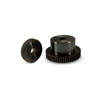
from Stock Drive Products & Sterling Instrument - SDP/SI
Industrial fasteners are hardware devices that join two or more items together, creating a semi-permanent or permanent connection. The fasteners most frequently used by machinery designers are screws, nuts, retaining rings, and various types of pins because of the basic role that they play in the... [See More]
- Pitch: 6.28 mm/tooth
- Outside Diameter: 2.36
- Teeth: 30
- Bore Diameter: 0.630

from QTC METRIC GEARS
6.28mm Pitch 30 Tooth Mild Steel Hubless Ratchet with Plain Bore [See More]
- Pitch: 6.28 mm/tooth
- Outside Diameter: 2.36
- Teeth: 30
- Bore Diameter: 0.591