
Metric Hypoid Gears
Description
Metric hypoid gears are a type of conical gear designed to transmit power between skewed shafts. These gears feature a unique tooth trace that is curved and offset from the gear center, allowing for configurations that accommodate a large diameter shaft. The teeth on a hypoid gear are positioned between a bevel gear and a spiral pinion, which contributes to their high strength and efficiency .
Working Principle
Hypoid gears operate by transmitting power between non-parallel and non-intersecting shafts, typically at right angles. The design includes an offset pinion, which allows for a larger contact area between the gear teeth, resulting in smoother operation and higher torque transmission. This offset also contributes to the gear's ability to achieve a large gear reduction, making them particularly useful in applications requiring high torque and efficiency .
Applications
Hypoid gears are commonly used in truck drive differentials, where the high torque and offset pinion are particularly valued. This design is beneficial in automotive applications where space constraints and the need for efficient power transmission are critical. Additionally, hypoid gears are used in various industrial machinery where precise and efficient power transfer is required .
Advantages over other Hypoid Gears
One of the primary advantages of metric hypoid gears over other types is their ability to achieve high strength and efficiency due to their unique tooth positioning and offset design. This allows for a larger contact area and smoother operation compared to traditional bevel gears. The offset pinion design also enables a larger gear reduction, which is advantageous in applications requiring significant torque .
Limitations
A notable limitation of hypoid gears is the mechanical efficiency loss due to the offset pinion. This design requires specific lubrication to maintain smooth and temperate operation, which can add to the maintenance requirements. Additionally, the complex geometry of hypoid gears necessitates precise manufacturing, which can increase initial costs .
Considerations
When considering metric hypoid gears, it is important to account for the initial costs associated with their complex design and manufacturing requirements. Operating expenses may also be higher due to the need for specialized lubrication and maintenance to ensure durability and accuracy. Replacement and maintenance costs should be factored into the overall cost of ownership, as the intricate design of hypoid gears can make them more challenging to service compared to simpler gear types .

from Shenzhen Besta Precision Machinery Co., Ltd.
With extensive experience in the gear manufacturing industry, Besta is pleased to introduce our line of bevel and spiral bevel gears, working with materials including aluminum, ductile iron, and stainless steel. In addition, we can work with non-metals like nylon, plastic, and phenolic, Our size... [See More]
- Design: Metric
- Module: 1 - 15
- Pressure Angle: 20°; 15°, 21.5° & 22.5°
- OD: 800
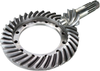
from Hymark/Kentucky Gauge
In hypoid bevel gears, the drive pinion is axially offset on the top or on the bottom. The pinion diameter is larger to enable higher transmissions. Hypoid bevel gears have smoother tooth engagement and a longer lifetime. They are used at high speeds, with heavy or small loads, for quiet operation... [See More]
- Design: Metric
- Module: 0.5-12.0, 0.8-10.0