HVAC Load Calculations: Basics of Heating, Cooling, and Radiant Heat Loads
HVAC (Heating, ventilation, and air conditioning) systems are essential systems helping to ensure comfortable and stable indoor temperatures. However, designing efficient HVAC systems for a building (or space) requires a deep understanding of several interplaying factors, ranging from the building’s construction materials to the varying heat contributions of the occupants (and equipment) in that space.
Heating, cooling, and radiant heat loads are essential HVAC loads considered when designing or sizing HVAC systems for an application. By accurately calculating these loads, HVAC professionals can design their system efficiently, reducing energy consumption and improving overall comfort levels.
This article presents basic equations and industry standards used for estimating HVAC loads.

Figure 1: Heat load, cooling load, and radiant heat loads are essential HVAC loads that are considered when designing or sizing HVAC systems for an application
Source: [evening_tao/Adobe Stock]
Heat Load Calculation
The first step that is taken when specifying the ideal product for cooling system application is to determine the heat load, which is simply the amount of heat generated by the space (or the building) to be cooled. Heat load calculations encompass the multiple factors contributing to heat in the building, such as internal heat sources (from occupants and electrical appliances).
When outdoor air is introduced into a building, the air absorbs the heat generated by the heat sources in the space. As a result, a simple and quick way to calculate the heat load would be to assume that all electrical energy entering a process is converted to heat. Therefore, the heat load can be calculated using:
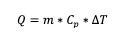
Where:
m = mass flow rate of the air (kg/s)
Cp = specific heat of air (J/kg°C)
 = temperature difference (°C)
However, heat load calculations are more complex in practical applications, involving several calculations and considerations. For instance, parameters such as the size and construction of the building, local climate, number of occupants and their usage schedules, and efficiency of insulation materials are considered for a well-detailed heat load estimation.
Learn more: ASHRAE Handbook Fundamentals .
Cooling load calculation
Cooling load describes the amount of heat energy to be removed from the building by the cooling system to maintain the indoor temperature within the acceptable range. Like heat load calculations, cooling loads calculations are complex, and the parameters for describing them are often intricately related. However, two commonly used methods in the industry for cooling load calculations are the RTS (Radiant Times Series) and the CLT (Cooling Load Temperature) methods, which have been developed by the American Society of Heating, Refrigerating, and Air-Conditioning Engineers (ASHRAE).
The Radiant Time Series method takes into account the transient heat flows
within the building. In simple terms, it accounts for the time-dependent
nature of heat transfer. The RTS method starts by identifying the various
heat sources that contribute to the cooling load (such as solar radiation
and heat generated by occupants and equipment). Using this information, it
then converts all the possible heat gains into equivalent temperature
differences before applying some specific cooling load factors to estimate
the cooling load. In contrast, the CLTD method is based on steady-state heat
transfer, where tabulated data are used to calculate the cooling loads
based on the cooling load temperature difference, the heat conducted
through the building envelope, and solar heat gain.
[Learn more about HVAC cooling on GlobalSpec]
Radiant heat load calculation
The radiant heat load describes the heat added to the space due to radiation. Sources of radiant heat load include direct solar radiation, indirect solar radiation, and radiant heat from equipment and lighting. The calculation for the radiant heat load is generally integrated into the RTS method, and the results allow engineers to correctly size HVAC systems and design effective shading and insulation strategies.
HVAC load calculations: Reach out to suppliers
This article has explored the basics of HVAC load calculations, especially for heating, cooling, and radiant heat loads. However, the design of HVAC systems is much more complex, involving several other considerations and calculations. Therefore, it is recommended to reach out to HVAC systems manufacturers to discuss application requirements.