|
 Preface
 TABLE OF CONTENTS
 Chapter 1 - Introduction
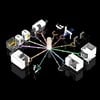
1IntroductionIn the past years before the personal computer (PC) was widely incorporated into industrial automation systems, all the faults that occurred in industrial processes were checked and dealt with by trained or experienced operators. For example, in the condition monitoring systems for the natural gas pipeline network, all operations were handled in a manual or semiautomatic manner, which, however, had some major drawbacks. For instance, the operator had to do the majority of the work by hand, the abnormal conditions could not be monitored and handled in real time, the remote measurement parameters could not be effectively monitored, and operators were prone to make mistakes in recording and manipulating a large amount of data. Therefore, it is highly necessary to automate the measurement operations as well as to improve the operating efficiency. In recent decades, this picture has been dramatically changed due to the wide adoption of industrial PC in a wide range of industrial applications. A typical industrial automation system, as illustrated in Fig. 1.1, is usually made up of the physical system, transducers, device drivers and data I/O, host computer, network server, and remote computers. Information technologies have been rapidly developed in recent years, and they have provided sufficient technical support for building modern industrial automation systems with more open architecture with respect to the previous ones. It turns out that the computerized real-time monitoring analysis  Fig. 1.1 A typical industrial automation system. and automated technologies can realize the full automation of an industrial measurement system. The combination of emerging information technologies with traditional condition monitoring systems allows for the continuous running status monitoring for essential equipment as well as comprehensive data processing and centralized resource management. It will significantly enhance the working efficiency of system operators and decision-makers. As a result, developing such systems with the aforementioned characteristics for achieving full industrial automation has a positive practical significance in both economy and technology perspectives. |