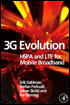
3G Evolution: HSPA and LTE for Mobile Broadband
Part I: Introduction

Chapter List

Chapter 1: Background of 3G evolution
Chapter 2: The motives behind the 3G evolution

From the first experiments with radio communication by Guglielmo Marconi in the 1890s, the road to truly mobile radio communication has been quite long. To understand the complex 3G mobile-communication systems of today, it is also important to understand where they came from and how cellular systems have evolved from an expensive technology for a few selected individuals to today's global mobile-communication systems used by almost half of the world's population. Developing mobile technologies has also changed, from being a national or regional concern, to becoming a very complex task undertaken by global standards-developing organizations suchasthe Third Generation Partnership Project (3GPP) and involving thousands of people.

1.1 History and Background of 3G

The cellular technologies specified by 3GPP are the most widely deployed in the world, with the number of users passing 2 billion in 2006. The latest step being studied and developed in 3GPP is an evolution of 3G into an evolved radio access referred to as the Long-Term Evolution (LTE) and an evolved packet access core network in the System Architecture Evolution (SAE). By 2009 2010, LTE and SAE are expected to be first deployed.

Looking back to when it all it started, it begun several decades ago with early deployments of analog cellular services.

1.1.1 Before 3G

The US Federal Communications Commission (FCC) approved the first commercial car-borne telephony service in 1946, operated by AT&T. In 1947 AT&T...

UNLIMITED FREE
ACCESS
TO THE WORLD'S BEST IDEAS

SUBMIT
Already a GlobalSpec user? Log in.

This is embarrasing...

An error occurred while processing the form. Please try again in a few minutes.

Customize Your GlobalSpec Experience

Category: GPRS Chips
Finish!
Privacy Policy

This is embarrasing...

An error occurred while processing the form. Please try again in a few minutes.