Aircraft Structures for Engineering Students, Fourth Edition
Section A3: Thin Plate Theory

Chapter List

Chapter 7: Bending of Thin Plates

Overview

Generally, we define a thin plate as a sheet of material whose thickness is small compared with its other dimensions but which is capable of resisting bending in addition to membrane forces. Such a plate forms a basic part of an aircraft structure, being, for example, the area of stressed skin bounded by adjacent stringers and ribs in a wing structure or by adjacent stringers and frames in a fuselage.

In this chapter we shall investigate the effect of a variety of loading and support conditions on the small deflection of rectangular plates. Two approaches are presented: an 'exact' theory based on the solution of a differential equation and an energy method relying on the principle of the stationary value of the total potential energy of the plate and its applied loading. The latter theory will subsequently be used in Chapter 9 to determine buckling loads for unstiffened and stiffened panels.

7.1 Pure Bending of Thin Plates

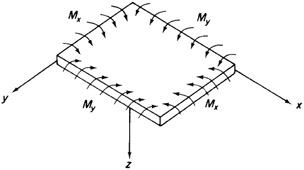
The thin rectangular plate of Fig. 7.1 is subjected to pure bending moments of intensity M x and M y per unit length uniformly distributed along its edges. The former bending moment is applied along the edges parallel to the y axis, the latter along the edges parallel to the x axis. We shall assume that these bending moments are positive when they produce compression at the upper surface of the plate and tension at the lower.


Figure 7.1: Plate...

UNLIMITED FREE
ACCESS
TO THE WORLD'S BEST IDEAS

SUBMIT
Already a GlobalSpec user? Log in.

This is embarrasing...

An error occurred while processing the form. Please try again in a few minutes.

Customize Your GlobalSpec Experience

Category: Plate Forming Services
Finish!
Privacy Policy

This is embarrasing...

An error occurred while processing the form. Please try again in a few minutes.