Catalysts for Upgrading Heavy Petroleum Feeds: Studies in Surface Science and Catalysis, Vol. 169

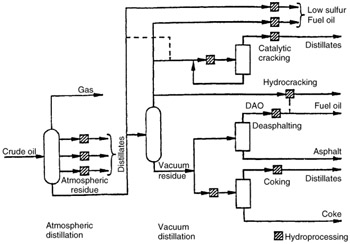
The simplified schematics of the petroleum refinery (Figure 2.1) indicate the presence of several hydroprocessing units. For the purpose of this book, the atmospheric residue (AR) boiling above 350 C (623 K) was chosen as the primary heavy feed from which other heavy feeds have been derived. Thus, AR can be subjected to several treatments, i.e., deasphalting, hydroprocessing and vacuum distillation. Products of the vacuum distillation are vacuum residue (VR) and VGO. Similarly as AR, VR can be either deasphalted to produce DAO and asphalt or directly hydroprocessed. The VGO is usually used as the feed for production of light and/or middle distillates either via hydroprocessing or via catalytic cracking. Other petroleum products obtained from VGO include lube base stock used for the preparation of lubricating oils. The products identified in Figure 2.1 as distillates are not subject of this book except those obtained by coking, i.e., heavy gas oil (HGO). According to Figure 2.1, the former products were produced during the atmospheric distillation and catalytic cracking.
The FCC and coking of heavy feeds form an integral part of many petroleum refineries. Virgin VGOs, as well as pretreated DAOs and HGOs have been typical feeds for the former process. However, after modifications of the conventional cracking units, RFCC process may also be able to handle the unpretreated DAO and ARs derived from sweet crudes. Hydroprocessing is the process of choice for heavier ARs and VRs, as well as topped heavy crudes. In an...