Design of High Frequency Integrated Analogue Filters

This book aims to systematically introduce the fundamentals and most recent advances of modern high frequency integrated analogue filters and to identify the most promising future directions.
 TABLE OF CONTENTS
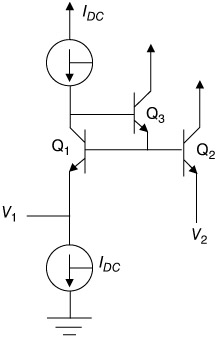
 Having discussed the synthesis of log domain filters at the top level, it is now appropriate to discuss some of the more interesting designs for log domain building blocks. We have already done some of this by showing some simple transconductor and integrator structures. The circuits shown thus far are useful in a variety of cases where there are not serious constraints on precision or power supply requirements. Suppose that we consider modifications or alternative circuits from this perspective. To begin, suppose we wish to improve the accuracy of the basic positive transconductor of Figure 4.7(a). Up to now, we have assumed that the transistor current gain, ?, is very large. In practice this will not be the case. Therefore, the base current of Q 2 will appear as an error both at the input to this transconductor and the output, since only the collector current of a bipolar transistor obeys the ideal exponential law in theory. We can cure at least part of this error by adding a third ' ? helper' transistor as shown in Figure 4.21. This reduces the base current error seen at the input; however, the output error is still there. Fortunately, the input error is usually more of a problem in log domain filter performance than the output error.
Looking at the negative transconductor of Figure 4.8(a) one can see that the base...