System Architecture with XML
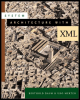
This guide comprehensively combines XML, the Internet, equalling Web services, which provide a great deal of strategic applications for your business.
 TABLE OF CONTENTS
 For early transactional systems, data storage was one of the most challenging aspects of computing. Today, with ubiquitous networks, the focus of software engineering has moved to communication. In this chapter we first introduce the conceptual aspects of communication. After describing a layered communication model, we look at the transportation environment for messages: channels and ports. Then we discuss the theory of speech acts that helps us to structure the exchange of messages and leads to protocol patterns.
In Section 6.5, we look closer into the anatomy of message implementation, and we discuss SOAP and XML Protocol as practical examples. In Section 6.6, we discuss both the classical ACID transactions and the newer, process-oriented, long-living transactions and how those transactions concepts can be applied to Web services. Security issues are covered in Section 6.8. This includes a discussion of two security-related standards: XML Signature and XML Encryption.
McCarthy s CBCL
As early as 1975 John McCarthy proposed a Common Business Communication Language (CBCL) (McCarthy 1999). As McCarthy observed, Developing an expressive Common Business Communication Language has proved unexpectedly difficult. The problem is not so much the syntax but that the problem is open-ended. You cannot stop at some stage and claim that all aspects are covered. For each business rule that is covered by the model, it is easy to find a more complicated business rule that is not yet covered. Just take the following rules describing shipment orders as an example:
Ship by express mail.
Ship by standard mail,...