Troubleshooting Switching Power Converters: A Hands-on Guide
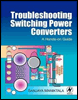
Chapter 2: High-Frequency Effects and the Importance of Input Decoupling

Lies, Damn Lies, and Schematics

A schematic hides more than it reveals. For example, it seems to imply that that every point of a circuit with a ground symbol hanging from it happens to be the same point (i.e., at the same voltage). Nothing could be further from the truth, especially when the PCB is faced with the job of transporting the high-frequency current harmonics associated with switching transitions. That is why it is never enough to simply look at an electrical schematic and then build or troubleshoot a switching regulator.

PCB Trace Impedances

A few millimeters of PCB trace length can become a veritable impedance wall for such harmonics, causing the voltage at one end of the trace to lift up (with respect to the other end), producing an unintended result somewhere or other. And when that impedance is predominantly inductive, this voltage kick can be really nasty, based on the simple equation V = Ld I/d t. Here d I/d t is the slope of the current edge, and L is the inductance associated with the trace section. Let's do the math here. A typical DC-DC converter may switch several amperes in 20ns. The rule of thumb for PCB trace inductance is 20nH per inch. So if we switch 1A through 1 in. of trace, we will get 1V of kickback. A switch of 2A will give 2V and so on. Depending upon where the offending PCB section is located,...

UNLIMITED FREE
ACCESS
TO THE WORLD'S BEST IDEAS

SUBMIT
Already a GlobalSpec user? Log in.

This is embarrasing...

An error occurred while processing the form. Please try again in a few minutes.

Customize Your GlobalSpec Experience

Category: Board Mount Transformers
Finish!
Privacy Policy

This is embarrasing...

An error occurred while processing the form. Please try again in a few minutes.