Global Positioning System: Theory and Applications, Volume II

From 1945 Through the 1970s, the Long Range Navigation System (Loran-C) was developed by the United States and the Soviet Union (the Soviet system is called Chayka) primarily for military use. In the 1970s, Loran-C was declared an official national system by the United States and Canada. These decisions spurred a wealth of civilian applications and tremendous commercial development. The integrated circuit and microprocessor improved the performance of Loran-C receivers, while greatly reducing their size and prize. Solid-state Loran transmitters were introduced, and these had much greater reliability and efficiency than their vacuum tube predecessors.
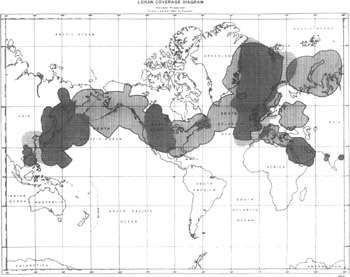
Today, Loran provides service to nearly a million maritime, airborne, and terrestrial users throughout most of the northern hemisphere. The coverage of Loran is shown in Fig. 1, where the coverage contours are for the extremely reliable ground wave coverage. Skywave propagation does provide extended coverage, but it is not as reliable.
Recently, the United States has added four new Loran transmitters to cover the middle of the United States (to fill the "midcontinent gap"). [1]