Intelligent Distributed Video Surveillance Systems

Bringing together a collection of the latest work in the field, this book details recent developments in machine vision algorithms capable of handling complex visual data acquired by camera systems.
 TABLE OF CONTENTS
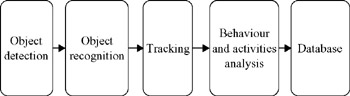
 This section summarises research that addresses the main image processing tasks that were identified in Section 1.2. A typical configuration of processing modules is illustrated in Figure 1.1. These modules constitute the low-level building blocks necessary for any distributed surveillance system. Therefore, each of the following sections outlines the most popular image processing techniques used in each of these modules. The interested reader can consult the references provided in this chapter for more details on these techniques.
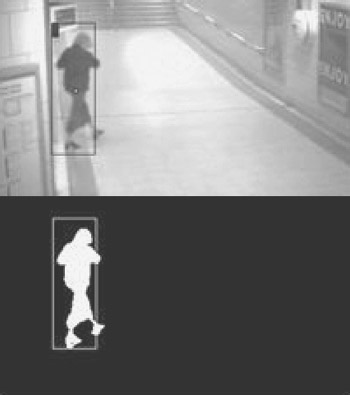
There are two main conventional approaches to object detection: temporal difference and background subtraction . The first approach consists in the subtraction of two consecutive frames followed by thresholding. The second technique is based on the subtraction of a background or reference model and the current image followed by a labelling process. After applying one of these approaches, morphological operations are typically applied to reduce the noise of the image difference. The temporal difference technique has good performance in dynamic environments because it is very adaptive, but it has a poor performance in extracting all the relevant object pixels. On the other hand, the background subtraction has a better performance in extracting object information but it is sensitive to dynamic changes in the environment (see Figures 1.2 and 1.3).