Managing and Securing a Cisco Structured Wireless-Aware Network (SWAN)

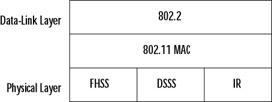
As in all 802.x standards, the 802.11 specification covers the operation of the Media Access Control (MAC) and physical layers. As seen in Figure 2.15, 802.11 defines a MAC sublayer, MAC services and protocols, and three physical (PHY) layers.
The three physical layer options for 802.11 are IR baseband PHY and two RF PHYs. Due to line-of-sight limitations, very little development has occurred with the IR PHY. The RF physical layer is composed of FHSS and DSSS in the 2.4 GHz band. All three physical layers operate at either 1 or 2 Mbps. The majority of 802.11 implementations utilize the DSSS method.
FHSS works by sending bursts of data over numerous frequencies. As the name implies, it hops between frequencies. Typically, the devices use up to four frequencies simultaneously to send information and only for a short period of time before hopping to new frequencies. The devices using FHSS agree upon the frequencies being used. In fact, due to the short time period of frequency use and device agreement of these frequencies, many autonomous networks can coexist in the same physical space.
DSSS functions by dividing the data into several pieces and simultaneously sending the pieces on as many different frequencies as possible, unlike FHSS, which sends on a limited number of frequencies. This process allows for greater transmission rates than FHSS, but is vulnerable to greater occurrences of interference. This is because the data is spanning a larger portion of the...