Advances in High Voltage Engineering

J.E. Dolan
Pulsed power deals with the generation of extremely high power, short duration impulses. Peak powers typically range from megawatt (MW) to terawatt (TW) levels, and pulse durations from nanoseconds to milliseconds. The aim of this review is to indicate the development of pulsed power as a discipline, and to discuss some of the key elements in pulsed power systems. The range of applications of pulsed power is also outlined.
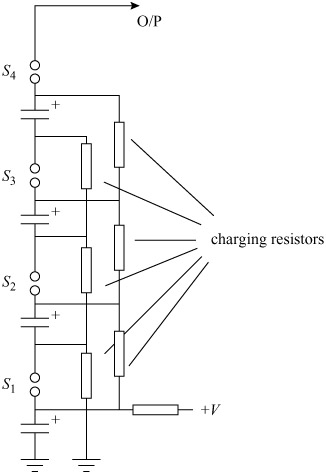
Pulsed power began in the 1920s when Erwin Marx at the Technical University of Braunschweig devised a novel form of high voltage impulse generator for lightning testing of high voltage power transmission equipment. In the Marx generator (Figure 13.1) a set of n capacitors are charged in parallel at moderate voltages (typically 10 100 kV). The capacitors are then switched into series connection to achieve an output impulse voltage which is a multiple n of the charging voltage. The series connection arises due to the sequential over-volting and breakdown of the spark gaps once the first gap breaks down. Output voltages up to 2 MV are readily achieved. The spark gap closure maintains the capacitors in series for the duration of the ensuing current discharge. In more recent years, the development of high energy and fast rise-time Marx banks has been driven by the requirements of flash radiography, ion beam generation, and plasma fusion drivers for ~MJ energy levels to be delivered in sub-microsecond timescales.
The first...