Developing E-Business Systems & Architectures: A Manager's Guide

This book provides managers with a road map to help them develop a strategic plan for their own transition to e-businesses.
 TABLE OF CONTENTS
 To make our discussion a little more concrete, let's consider the hypothetical order fulfillment process illustrated in Figure 3.6. Let's assume this business process belongs to Stereos-R-Us and that this process sells a variety of different types of stereo sound systems to individuals and wholesalers. While hardly comprehensive, we've illustrated the major steps or groups involved in the stereo order fulfillment process. This process is a conventional business process that was improved somewhat in the early 1990s, but is otherwise much the same as it was in the early 1980s.
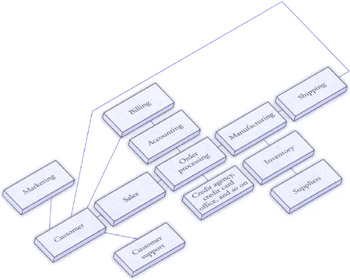
The Stereos-R-Us marketing department runs ads in trade magazines and cosponsors occasional ads on television. In addition, it sometimes runs a direct mail campaign to encourage the purchase of stereos. The sales force takes orders. Stereos-R-Us offers tailoring options to its customers. Thus, for example, stereos come in silver, metal, or black. Similarly, they can have regular or heavy-duty parts, and so forth. The salesperson indicates the tailoring options as part of the order. Salespeople visit major wholesale sites and they talk with others by phone. They fill out an order form when they make a sale and submit it to the order processing department. Order processing does three things. First, it determines that the customer is creditworthy. To do this, it requests information from credit card or credit rating agencies. If appropriate, the order is approved.
Once the order is approved, order processing...