Guide to the Unified Process Featuring UML, Java and Design Patterns

This chapter examines the relationship between phases and, in particular disciplines. It also considers iterations and how they fit into the Unified Process life cycle. It concludes by briefly discussing cycles and how they drive successive applications of the four phases.
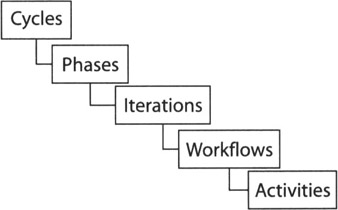
The primary focus in this book so far has been on the disciplines that direct the designers and developers during the production of the software system. However, these disciplines are organized into iterations (of course there may only be a single iteration!). In turn, the iterations are organized into phases. The four phases were discussed back in Chapter 3; however, it is worth returning to the phases and considering them in more detail here. In turn, the phases are organized into cycles which lead to successive releases of the product (see Figure 10.1).
As has been shown, disciplines determine the order in which activities are carried out, while activities determine how things are done and how artefacts are produced. So where do the phases fit in? Essentially they highlight what the current emphasis should be at any particular point in the project. We will consider this in greater detail below.
So phases highlight what the emphasis in the project should be at any particular point in time? What does that mean? Let us first consider the more traditional view of software development. In this view:
Many projects...