Resource Recovery and Recycling from Metallurgical Wastes
In addition to common precious metals, materials coming into use in electronics and semiconductor industries contain, in small proportion, rare metals of very limited availability, such as gallium, germanium and indium. The potential demand is seen as greater than supply (Jacobson, 1988). There is thus a great incentive for the recycling of these metals. Scrap selenium contaminated with elements such as tellurium, arsenic and chlorine is converted to a mixture of oxides to recover high purity selenium (Badesha, 1985). In another method, granulated scrap alloy containing arsenic and selenium is treated with caustic soda, followed by oxidation to recover the valuable constituents (Henstock, 1996, p. 287)).
7.9.1. Gallium has been recovered from residue containing both gallium and arsenic by treating with chlorine gas to form crude gallium and arsenic chlorides. By electrodeposition very high purity (99.9999%) gallium is obtained (Kubo, 1987). Gallium is also used for growing semiconductor single crystals of gallium arsenide for light emitting diode (LED) and laser diode (LD). Recycling of gallium from the arsenide scraps is of great practical interest as there are very few natural occurrences of this metal.
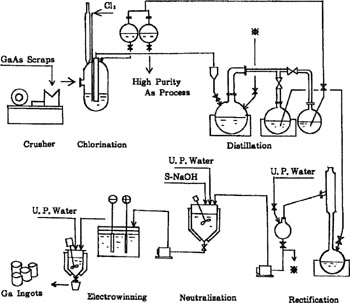
A cost effective process to recover high purity gallium from gallium arsenide scrap has been developed (Kubo et al., 1990). It comprises a series of steps, as depicted in Figure 7.41.
Various types of scrap are crushed to 2 5 mm size. The crushed scraps...