Understanding Physics

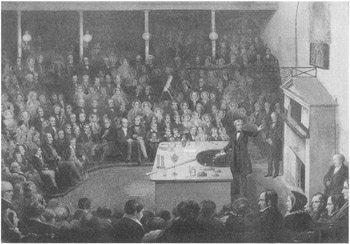
On April 11, 1846, the distinguished physicist Charles Wheatstone was scheduled to give a lecture at the Royal Institution in London. Michael Faraday was to introduce Wheatstone to the audience. At the last minute, just as Faraday and Wheatstone were about to enter the lecture hall, Wheatstone got stage fright, turned around, and ran out into the street. Faraday had to improvise and give a lecture himself. Normally, Faraday discussed in public only his actual experiments. But on this occasion he revealed certain speculations which, as he later admitted, he would never have made public had he not suddenly been forced to speak for an hour although these speculations soon changed physics.
Faraday's speculations dealt with the nature of light. Faraday, like Oersted before him, believed that all the forces of nature are somehow connected. Electricity and magnetism, for example, could not be separate forces that just happen to exist in the same universe. Rather, they must be different forms of one basic phenomenon. This belief paralleled that of Immanuel Kant, Friedrich Wilhelm Joseph von Schelling, and other German nature philosophers at the beginning of the nineteenth century. It had inspired Oersted to search in the laboratory for a connection between electricity and magnetism. Eventually he found such a connection in his discovery that an electric current in a conductor can turn a nearby magnet (see Chapter 10).
Faraday, too, had been guided by a...