Future Mobile Networks: 3G and Beyond

A valuable resource which presents technological advances and market expectations to those in the mobile communications field.
 TABLE OF CONTENTS
 W Johnston
There are now more mobile telephones in the UK than fixed lines and the number of PDAs is increasing rapidly. Customers buy a telephone for the looks or the features and often do not care who the operator is. Mobile devices are the gateway to all telecommunications networks and services and can consequently be used to increase customers and therefore generate revenue for a network operator. With so many services and applications being promised for 3rd generation (3G) networks, operators now face the challenge both of installing the network capability and of procuring terminal devices that aim to match at least some of these expectations.
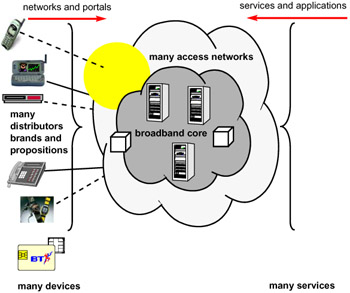
Figure 10.1 shows an end-to-end representation of a network. Traditional network operators spend a lot of time and effort on developing and implementing networks and ensuring they are compatible both internally and with other licensed operators (OLOs). Generally, there has been less in-depth involvement with service development and integration and very little involvement with terminal development/manufacture/implementation. Given the complexity and flexibility of 3G, this situation must change if 3G operators are to develop an optimised solution. BT recognises the importance of the terminals and, consequently, is scoping its requirements with all the world's device manufacturers to fulfil the 3G requirements.
The word 'terminal' can mean anything from the fixed telephone on the desk to set-top boxes or an integrated handheld cellphone with organiser. In order to bound this discussion, in this chapter terminals will relate only...