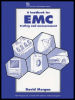
A Handbook For EMC Testing and Measurement
Over the last 20 years traditional EMC testing has concentrated on radiated and conducted emission and susceptibility testing. This is carried out by examining or generating signals as a function of frequency, and this activity is sometimes referred to as operating in the frequency domain. Some discontinuous signal tests have also been carried out as part of EMC work with specifications such as MIL STD 461. These spike tests simulate switching transients which may be induced onto power lines when a neighbouring unit is operated. Other additional power-line surge and drop-out tests have also grown in importance over the years.
Now that EMC design is becoming a sophisticated and integrated part of electronic design, one sees that the effects of both continuous interference and transient effects are having to be designed out at the same time, and usually by the same design team, as solutions for one type of interference may compromise those for another. Cost-effective protection across the whole field of RF interference demands that a coherent set of design techniques are employed to combat both continuous and transient interference with the minimum component count and cost.
In some cases, the solutions to transient problems using nonlinear voltage clipping devices, such as zener diodes or spark gaps, are not used at all in controlling continuous interference. However, to be effective their location in the circuit and their position on the circuit board can be crucial, but this may compromise the optimum design for reducing...