High Performance Communication Networks, Second Edition
An advanced textbook surveying high-performance communication networks.
 TABLE OF CONTENTS
 We first explain, using a very simple network, that the most important QoS for circuit-switched networks is the blocking probability. We then show how the blocking probability for circuit-switched networks depends on routing and admission control.
Figure 8.5 illustrates a simple circuit-switched network. The network consists of two groups of telephone sets in two buildings. The telephone sets in each building are connected to a switch (a PBX, or private branch exchange) and the two PBXs are connected by two lines.
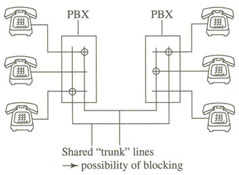
You see that it is possible for a call to be requested between the two buildings when the two lines between these buildings are busy. Using a smaller number of lines between the buildings than might be needed in the worst case leads to the possibility of calls being blocked. Of course, in any realistic situation it would be impractical to use the maximum possible number of lines. For instance, if the two buildings had 100 telephone sets each, then 100 lines would be needed between the two buildings to allow all the telephone sets to be used at the same time for calls between the buildings. In practice, the likelihood of such a situation is exceedingly small, so...