MPEG Handbook: MPEG-1, MPEG-2, MPEG-4

The clarity of explanation and depth of technical detail combine to make this book an essential and definitive reference work.
 TABLE OF CONTENTS
 Chapter 1 introduced these concepts in a general sense and now they will be treated with specific reference to MPEG. Figure 5.18(a) shows that spatial redundancy is redundancy within a single picture or object, for example repeated pixel values in a large area of blue sky. Temporal redundancy (b) exists between successive pictures or objects.
In MPEG, where temporal compression is used, the current picture/ object is not sent in its entirety; instead the difference between the current picture/object and the previous one is sent. The decoder already has the previous picture/object, and so it can add the difference, or residual image, to make the current picture/object. A residual image is created by subtracting every pixel in one picture/object from the corresponding pixel in another. This is trivially easy when pictures are restricted to progressive scan, as in MPEG-1, but MPEG-2 had to develop greater complexity (continued in MPEG-4) so that this can also be done with interlaced pictures. The handling of interlace in MPEG will be detailed later.
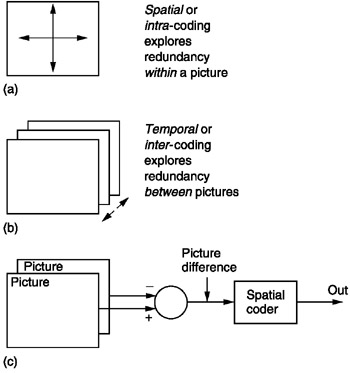
A residual is an image of a kind, although not a viewable one, and so should contain some kind of spatial redundancy. Figure 5.18(c) shows that MPEG takes advantage of both forms of redundancy. Residual images are spatially compressed prior...