MPEG Handbook: MPEG-1, MPEG-2, MPEG-4

The clarity of explanation and depth of technical detail combine to make this book an essential and definitive reference work.
 TABLE OF CONTENTS
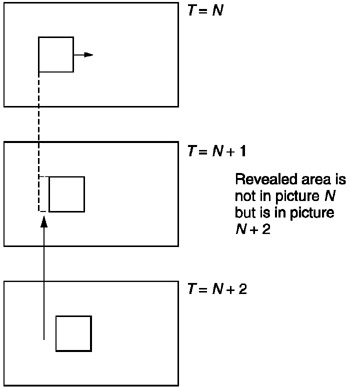
 Motion-compensated predictive coding is a useful compression technique, but it does have the drawback that it can only take data from a previous picture.
Where moving objects reveal a background this is completely unknown in previous pictures and forward prediction fails. However, more of the background is visible in later pictures. Figure 5.24 shows the concept. In the centre of the diagram, a moving object has revealed some background. The previous picture can contribute nothing, whereas the next picture contains all that is required.
Bidirectional coding is shown in Figure 5.25. A bidirectional or B macroblock can be created using a combination of motion compensation and the addition of a prediction error. This can be done by forward prediction from a previous picture or backward prediction from a subsequent picture. It is also possible to use an average of both forward and backward prediction. On noisy material this may result in some reduction in bit rate. The technique is also a useful way of portraying a dissolve.
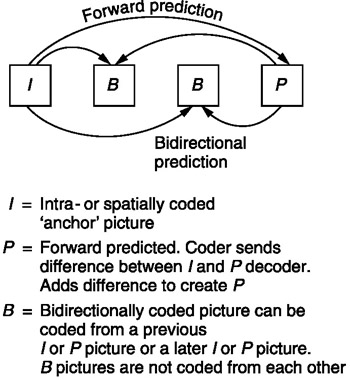
The averaging process in MPEG is a simple linear interpolation which works well when only one B picture exists between the reference pictures before and after. A larger number of B pictures would require weighted...