Consider a specialized beam analysis governing only the statics of bending and torsion of a prismatic beam. We start with the strain energy per unit length, to which we adjoin the kinematical equation that relates ? to ??, using a column matrix of Lagrange multipliers denoted by ?. This yields the augmented strain energy as
where D is a 3 3 matrix of the bending and torsional stiffness properties; for example, see Eq. (4.112). Setting the variation equal to zero, one obtains
or
Looking only at the coefficients of ?? T , we see that
or
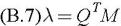
where M is the moment and
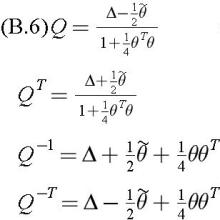
Thus,
Using Q T M for the Lagrange multiplier in the augmented strain energy, one obtains
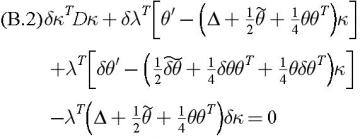
Taking the variation, one can now write
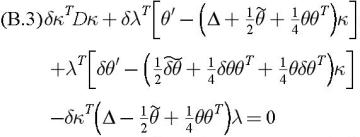
which becomes
If we introduce  as in Eqs. (5.49), this expression can be simplified to
or
Now we make use of the relation Q ??= ?, which holds for a prismatic beam, together with Eq. (5.11) to express  . Thus, the variation of the augmented strain energy can finally be written as
All of these terms are identical to their counterparts in Eq. (5.50) if the ?? term is integrated by parts, and the relation K= ? for a prismatic beam is used.
It is noted that this procedure can be generalized to find all the Lagrange multipliers needed to derive Eq. (5.50).
Copyright The American Institute of Aeronautics and Astronautics, Inc. 2006 under license agreement with Books24x7

 TABLE OF CONTENTS