Pattern Recognition in Industry

The quality of the product made in a distillation tower is governed by the temperatures in the series of trays within the tower. This case study deals with the development of a model for predicting temperatures in six distillation tower trays under varying operating conditions. The tray temperatures are important in that they determine the distillation tower's product quality.
The issue in this particular case was that operating data had been gathered on a minute-by-minute basis, resulting in 10,000 data points representing 1 week of operation. To avoid biasing training by a large number of data points over periods of operations where conditions essentially remained unchanged, the data needed to be mined for identifying distinctly different operating conditions within this dataset before they were used to develop a model for predicting the tower tray temperatures.
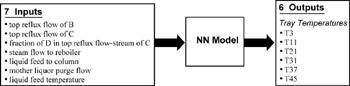
The input parameters used as inputs to the model included the feed rate, feed temperature, flow rates and chemical composition of the reflux streams, purge flow rate, and the rate of steam flowing to the reboiler. The outcomes predicted by the model were the temperatures in six trays at different positions in the tower. The model configuration is shown in Figure 17.1.
The self-organizing methodology described in the earlier chapters was used to separate the data into clusters identifying distinctly different operating conditions. This procedure was performed on the seven-dimensional input data set. The data for each variable...