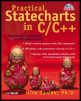
Practical Statecharts in C/C++: Quantum Programming for Embedded Systems
I would advise students to pay more attention to the fundamental ideas rather than the latest technology. The technology will be out-of-date before they graduate. Fundamental ideas never get out of date.
David Parnas
For many years, I have been looking for a book or a magazine article that describes a truly practical and reasonably flexible [1] way of coding statecharts in a mainstream programming language such as C or C++. I have never found such a technique.
I believe that this book is the first to provide what has been missing so far a flexible, efficient, portable, maintainable, and truly practical implementation of statecharts that takes full advantage of behavioral inheritance. This book is perhaps also the first to offer complete C and C++ code for a highly portable statechart-based framework for the rapid development of embedded, real-time applications.
My vision for this book, however, goes further than an explanation of the code. By providing concrete implementations of fundamental concepts, such as behavioral inheritance and active object based computing, the book lays the groundwork for a new programming paradigm, which I call Quantum Programming (QP).
This last chapter summarizes the key elements of QP, how it relates to other trends in programming, and what impact I think it might have in the future.
[1]I have never been satisfied with the techniques that require explicit coding of transition chains (see Chapter 3) because it leads to inflexible, hard-to-maintain code practically defeats the purpose of using statecharts...