Properties of Teflon

This handy reference explains the discovery, properties, application, and products of teflons, including the harmful effects of teflon.
Teflon is an odorless and a colorless powder. It begins to melt at 621 0F or 327 0C. The density of Teflon lies between 2.13 and 2.19g.
Chemically, Teflon belongs to the class of paraffin polymers. However, in this paraffin, fluorine atoms replace all the hydrogen atoms. Teflon is produced from free radical vinyl polymerization of tetraflouroethylene, resulting in the formation of polytetraflouroethylene or Teflon. The ensuing polymerization reaction is shown in Figure 1-1:
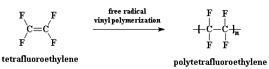
In the polymerization reaction, each polymer unit has a carbon chain as its backbone and each carbon atom is attached to two fluorine atoms, as shown in Figure 1-2:
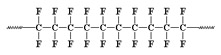
Teflon is one of the largest molecules known. Depending on the length of the polymer chain, the molecular weight of Teflon can go up to 30,000,000 or more.
The nonstick property of Teflon is because of the presence of fluorine in its molecular formula. The bond between carbon and fluorine is extremely strong and stable. The bond is so strong that the molecules tend to stay away from all other neighboring molecules of any type. Fluorine atoms of one molecule move toward the fluorine atoms of another molecule. This makes the structure very closely packed. As a result, Teflon does not allow closeness with any molecule other than one of its own. Consequently, the material becomes nonstick and chemically inert.
Some important characteristics of...

 TABLE OF CONTENTS