Total E-Mail Marketing

This clever text explains how to plan and execute e-mail campaigns which integrate with other online and offline communications, and is intended for customer acquisition and retention.
 TABLE OF CONTENTS
 This is important. We covered the merits of opt-in and opt-out as part of the introduction to permission marketing in Chapter 2, but what does opt-in mean in practice, at the level of boxes on forms and associated wording? In making these decisions, what we have to achieve is a balance between obtaining quality profiles and legal and ethical constraints. Many e-mail marketing gurus and legal advisers say that e-mail must be opt-in, and this is the received wisdom. But when faced with the reality of designing a form for collecting prospects, the reality is not this simple. Despite the opt-in mantra, many companies are not practising true opt-in: it all depends on how the forms are designed.
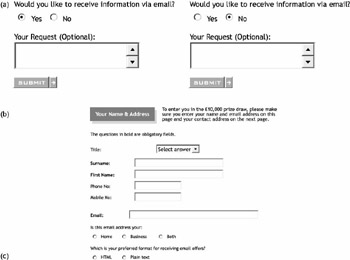
True opt-in requires the potential customer to agree proactively that they are prepared to receive future communications by selecting the option using a tick-box or ratio-button. Opt-out is where the person completing the form has to decline proactively the offer of receiving further communications. Consider the alternatives in Figure 4.13. Which is opt-in? Figure 4.13(a) is clearly an opt-in form, whereas Figure 4.13(b) is an opt-out design, but what about Figure 4.13(c)? This is less clear: it uses an opt-out approach, but it is more subtle. The implication is, from the way in which the question is phrased, that it is agreed that future information can be received.
Permission...