Web Accessibility for People with Disabilities
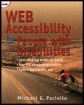
This is a great guide that shows you how and why to make your Web site accessible to people with disabilities.
 TABLE OF CONTENTS
 Because of the wide variance in human abilities, it s extremely difficult to design a human interface for a product such as the Web in a way that is completely accessible to all people, particularly in its first or second iteration. For example, while Web access to people with disabilities is a major issue, internationalization of the Web is an even larger one. Web content tends to be primarily available in English, though recent strides in translation services have made it easier to produce multilingual web sites.
Just as the international community is disparate, the community of people with disabilities is also disparate by nature; thus, it is almost impossible to make the World Wide Web completely accessible to every person with a disability. This is not an excuse to justify the inaccessibility of the Web it s a fact of life. Within every community of disability there exists degrees of ability; not every person with a visual disability is totally blind, not all people with mobility disabilities are paralyzed, and certainly not all people who are hearing impaired are deaf. Therefore, it is incumbent upon a system administrator to become familiar with a handful of tools and utilities that provide additional assistance to a user with a disability.
In this chapter, I provide an overview of the available applications mostly software specifically designed to enhance and improve the Web experience for people with disabilities. There are several operating system level features you can also use to simplify...