The Art of Multiprocessor Programming
Chapter 11: Concurrent Stacks and Elimination

11.1 Introduction

The Stack class is a collection of items (of type T) that provides push() and pop() methods satisfying the last-in-first-out (LIFO) property: the last item pushed is the first popped. This chapter considers how to implement concurrent stacks. At first glance, stacks seem to provide little opportunity for concurrency, because push() and pop() calls seem to need to synchronize at the top of the stack. Surprisingly, perhaps, stacks are not inherently sequential. In this chapter, we show how to implement concurrent stacks that can achieve a high degree of parallelism. As a first step, we consider how to build a lock-free stack in which pushes and pops synchronize at a single location.

11.2 An Unbounded Lock-Free Stack

Fig. 11.1 shows a concurrent LockFreeStack class, whose code appears in Figs. 11.2, 11.3 and 11.4. The lock-free stack is a linked list, where the top field points to the first node (or null if the stack is empty.) For simplicity, we usually assume it is illegal to add a null value to a stack.
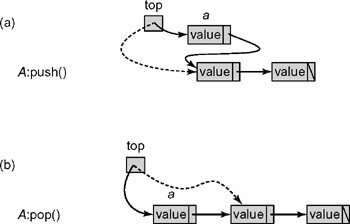

Figure 11.1: A Lock-free stack. In Part (a) a thread pushes value a into the stack by applying a compareAndSet() to the top field. In Part (b) a thread pops value a from the stack by applying a compareAndSet() to the top field.
  1  <b class="bold">public class</b> LockFreeStack {  2    AtomicReference top = ...

UNLIMITED FREE
ACCESS
TO THE WORLD'S BEST IDEAS

SUBMIT
Already a GlobalSpec user? Log in.

This is embarrasing...

An error occurred while processing the form. Please try again in a few minutes.

Customize Your GlobalSpec Experience

Category: Pallet Dispensers
Finish!
Privacy Policy

This is embarrasing...

An error occurred while processing the form. Please try again in a few minutes.