Business Intelligence: The Savvy Manager's Guide: Getting Onboard with Emerging IT

This quick reference guide overviews the best practices, tools, methods, and processes used to transform an organization's data into actionable knowledge.
 TABLE OF CONTENTS
 We have articulated the value of managing our information as an asset, we have explored the added value that can be derived through instituting business analytics in the organizations, and we have lined up the right senior-level sponsors for our business intelligence (BI) program. Now what? The time has come to discuss a high-level architecture required for implementing the BI program.
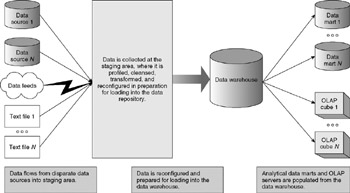
Realize that the BI process essentially revolves around the ability to flow large amounts of disparate data into a single repository and then in turn to flow restructured data for decision-support purposes out to data marts and related analytic process, as is seen in Figure 4.1. Designing the program is the process of:
Understanding the business requirements
Determining what kinds of analytical applications are needed to support those requirements
Determining the subject areas around which those analytical areas revolve
Determining what kind of subject-oriented information framework will support those applications
Determining what information is needed to feed the information framework
Providing the means for integrating that data into the information framework
Mapping those requirements onto a general BI architecture
The focus of this chapter is to provide the manager with a working vocabulary based on a high-level view of the BI environment. Although my goal is to provide a 50,000-foot view of the entire process, there are clearly some concepts that beg for deeper discussion, and those topics are covered in later chapters. Because I do not want to...