Corporate Portals Empowered with XML and Web Services

Architecture begins where engineering ends.
Walter Gropius
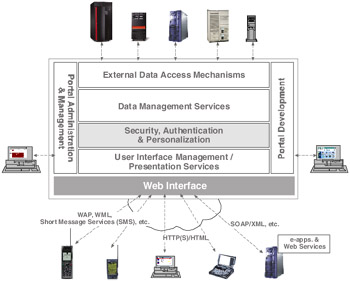
There is no single "industry standard" architectural framework for corporate portals at least not yet. Nonetheless, all corporate portals irrespective of the orientation of their parent company, the nature of their content, or the way they are implemented always share a common set of mandatory core functionality. At a minimum, this core portal functionality must include:
Interface to the Web
User interface management (i.e., presentation services)
External data access mechanisms
Data management services
Security, authentication, and personalization
Portal development tools
Portal administration and management tools
The need for these discrete functional components, in which each component has logical and very specific relationships with the other components, ensures that all corporate portals start off with a common inherent structure. This basic common-to-all structural framework can easily be leveraged to serve as the foundation for a solid but extensible architectural reference for future corporate portals. Figure 3.1 illustrates a high-level view of a practical and flexible architectural reference for contemporary corporate portals that is built around the mandatory, prerequisite functional components required to realize a credible portal. The architecture shown in Figure 3.1 will be extended and refined during the course of this chapter.
Functions such as aggregation, search, collaboration, syndication, document management, business-intelligence gathering, and workflow management can be systematically plugged into the data management services component to flesh out this architecture. Similarly, the Web interface component, which in practice would typically be realized...