Cruise Operations Management

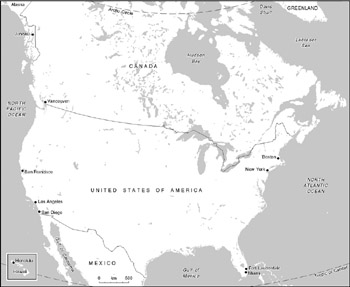
North America provides a number of embarkation points where US customers can join cruises and where overseas customers can join as fly-cruise passengers. In some cases these ports are home ports for US vessels and cruise companies. In addition, cruise itineraries can be constructed from US and Canadian ports to meet passengers' needs for cultural and geographical attractions. Irrespective of a cruise ship's flag or country of registration, because of the actions of US port health officials there are critical implications from the standpoint of port health for ships visiting US ports (which are examined in depth elsewhere) (Figure 4.4).
North America is the world's largest cruise market. As a result of concerns about security abroad, the number of cruise passengers joining from US ports has seen considerable growth. Of the top five cruise destinations in the world (Wild and Dearing, 2004a), Miami and Port Everglades are as number 1 and 2, respectively, and Port Canaveral is number 4. All three ports are in Florida. Cruise companies have benefited by consolidating their operational support in the United States and creating economies of scale from supply networks for merged brands. In addition, cruise companies have become horizontally and vertically integrated in their operations. Within the cruise industry, horizontal integration is attained by using different brands strategically within a variety of market segments. Vertical integration is achieved by creating synergies and generating revenue from ownership of parallel operations such as shore excursions, travel agents,...