Directing the Flow of Product: A Guide to Improving Supply Chain Planning

The sales forecasting discipline has advanced steadily over the last several decades intandem with planning. While we view forecasting as a separate field from planning and do not reallycover it in this volume, we must speak to the relationship between forecasting and planning. Goodforecasts significantly improve operations efficiency. For example, a classic rule of thumb is thatreducing forecast error by half allows a one-sixth reduction in supply chain inventory. Because wewill not be returning to forecasting in this volume, our description in this section will be moreoriented toward contemporary best practice and less historical than most of this chapter hasbeen.
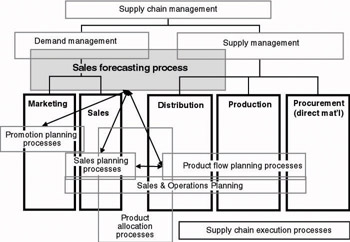
One of the subtlest and most often confused aspects of planning product flow is itsrelationship to forecasting and demand management. Figure2.4 is a brazen attempt to impose order here and to diagram some of the relationships weneed to discuss, in particular that sales forecasting, sales planning, and product flow planningare distinct activities. While the reader will likely react I don t think about these things inthis way, bear with us and we will try to illuminate a few points.
We have shown five traditional functional organizations here in heavy rectangles.Conceptually above them are the ideas of supply chain management, demand management, and supplymanagement. Marketing and sales are clustered under demand management, while distribution,production, and procurement are under supply. Key planning processes are then located in thisorganizational space: promotion planning, sales planning, and product flow planning (with...