Mr. G.E.Curtis calls my attention to the fact that the conclusion that the power required to maintain the horizontal flight of an aeroplane diminishes with the increasing speeds that it attains, may be deductively shown by the following analysis:
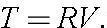
Representing the work to be done per second by T, the resistance to horizontal motion by R, and the horizontal velocity by V, we have by definition
Substituting for R its value, W tan ? (see p. 65), W being the weight of the plane, we have the equation
in which ? and V are dependent variables. The curves of soaring speed (Fig. 9) enable us, in the case of a few planes, to express ? in terms of V, but, for any plane and without actually obtaining an analytical relation between V and ?, we may determine the character of the function T, i. e., whether it increases or decreases with V, in the following manner:
Differentiating with respect to V, we obtain
Now, since in flight ? is a very small angle, tan ? will be small as compared with the term  . Hence the sign of the latter factor
  will control the sign of
  Now, since V increases as ? diminishes,
  is negative, which makes the term
  negative, and therefore, in general, T is a decreasing function of V. In other words, neglecting...
Copyright The American Institute of Aeronautics and Astronautics, Inc. 2006 under license agreement with Books24x7


 TABLE OF CONTENTS