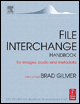
File Interchange Handbook: For Images, Audio, and Metadata
Nick Vicars-Harris [*]
The Advanced Systems Format (ASF) is an extensible file format designed to store coordinated multimedia data on a timeline for playback on devices and personal computers. This chapter provides an overview of the platform that supports the format on a PC as well as a detailed specification of ASF.
The file format was originally designed around providing support for streaming over the Internet or a local area network (LAN); hence, its initial name was Advanced Streaming Format. Since the initial implementation, the platform that supports the writing and reading of ASF files has gone through some considerable changes to enable the format to be used in a much wider variety of scenarios including editing, digital distribution, archiving, streaming, and, of course, PC and device playback.
ASF is an extensible file format designed around enabling the more common audio and video timeline playback. Through the platform the software development kits (SDKs) and application program interfaces (APIs) it is able to support a much broader range of media- and nonmedia-related streams that can be synchronized to the same timeline within the same file; these are discussed in more detail later in this chapter.
With respect to more common audio and video types, ASF is compression agnostic. Microsoft uses ASF with its own Windows Media Audio and Video codecs (currently version 9); other companies use ASF both with Microsoft codecs and with non-Microsoft codecs such as MPEG2 for PC- and hardware-based delivery...