Flight Catering, Second Edition

Fully endorsed by the International Flight Catering Association, this authoritative guide takes the reader through every aspect of in-flight catering including marketing, on board service, cost control and logistics.
 TABLE OF CONTENTS
 Provide a brief overview of the relationships between the four different stakeholders concerned with flight catering
Identify the role of the four stakeholders within in-flight service
Explain the nature of contracts and the tendering process between airlines and caterers
Understand the implications of alternative approaches to on-board food service
Travelling by aeroplane can be quite hectic. Getting to the airport, check-in, immigration and security procedures are only the start. After boarding, the cabin crew undertake a carefully coordinated series of tasks, ranging from delivering blankets and headphones to drinks and meal service, all within a confined space in a finite period of time. Yet, passengers are largely unaware of the work and logistics that have gone into their flight service in order to deliver the tremendous number of meals in very restrictive conditions.
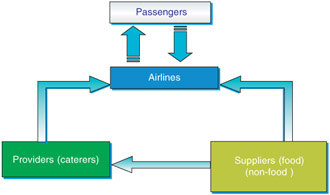
In the last chapter we saw that as flight catering developed, four separate groups or stakeholders emerged in the industry. Along with the passengers and airlines, suppliers to the industry were needed from the very earliest days and dedicated flight catering companies were founded in the 1940s and 1950s. In some cases, airlines formed their own flight catering divisions, in other cases these were independent of any airline.
The relationship between these four stakeholders is shown in Figure 2.1. As a result of the fragmentary and international nature of the business, tight interfaces are required between flying passengers and the airlines and between the airline and the providers and suppliers.