Modern Cable Television Technology: Video, Voice, and Data Communications
A technical reference and handbook for electronics and telecommunications engineers working with cable television transmission systems.
 TABLE OF CONTENTS
 The various parts of the broadband distribution system, the trunk, coaxial distribution, and drop, must work together to provide a transmission path whose performance allows delivery of adequate quality signals to the end user. This means that the total system performance requirements must be defined and that the allowable signal degradation must be allocated among signal acquisition, headend processing, distribution system, and terminal equipment.
This chapter will first discuss quality standards, then the question of allocation. Next, it will deal with the calculation of the cascaded broadband network sections. Finally, it will discuss the typical performance of a modern HFC distribution system, including factors that are not normally part of the cascaded network calculations, such as group delay and several classes of undesired signals that affect transmission channels.
In order to understand how performance standards are related, it is important to first determine the entire chain from signal generation to end user. The components of this chain will vary depending on the service, of course. Some signals may be generated in the headend or even closer to the subscriber, whereas others will be generated thousands of miles away. Figure 13.1 illustrates an example of the transmission elements through which an analog video signal may be sent.
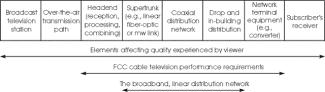
The video source in this example is a television broadcasting station. The source degradation will include some level of white noise, crosstalk, transmitter distortion, and possibly quantizing noise if the video or audio were digitized in any part of the process. Often the (analog NTSC) video S/N is limited by the originating camera and further degraded by a videotape recording and playback process to result in a 55 60-dB input to the transmitter. [1]The broadcast transmitter diplexing filter (used to combine visual and aural signals) and antenna will affect the frequency response, whereas visual transmitter incidental carrier phase modulation (ICPM) limits attainable stereo audio performance.
The source-to-headend path, if the headend is receiving the signal via the normal transmission path, might include multipath distortion (echoes resulting from signals bouncing off objects to create more than one transmission path), frequency response variations due to receiving antenna characteristics, electrical noise interference, and a host of other factors.
Within the headend complex, the signal may be demodulated, digitized, switched, amplified, combined with other signals, modulated, and/or shifted in frequency. In some cases, signals may be received at a different location than where they are finally combined into...